
A Farewell for a Man Who Never Took Anything TSeriously
The family in this story is a composite, drawn from the kinds of ceremonies Celebrants help families create every week.
"No funeral," Carol said. "Ray hated funerals. He'd have walked out of his own."
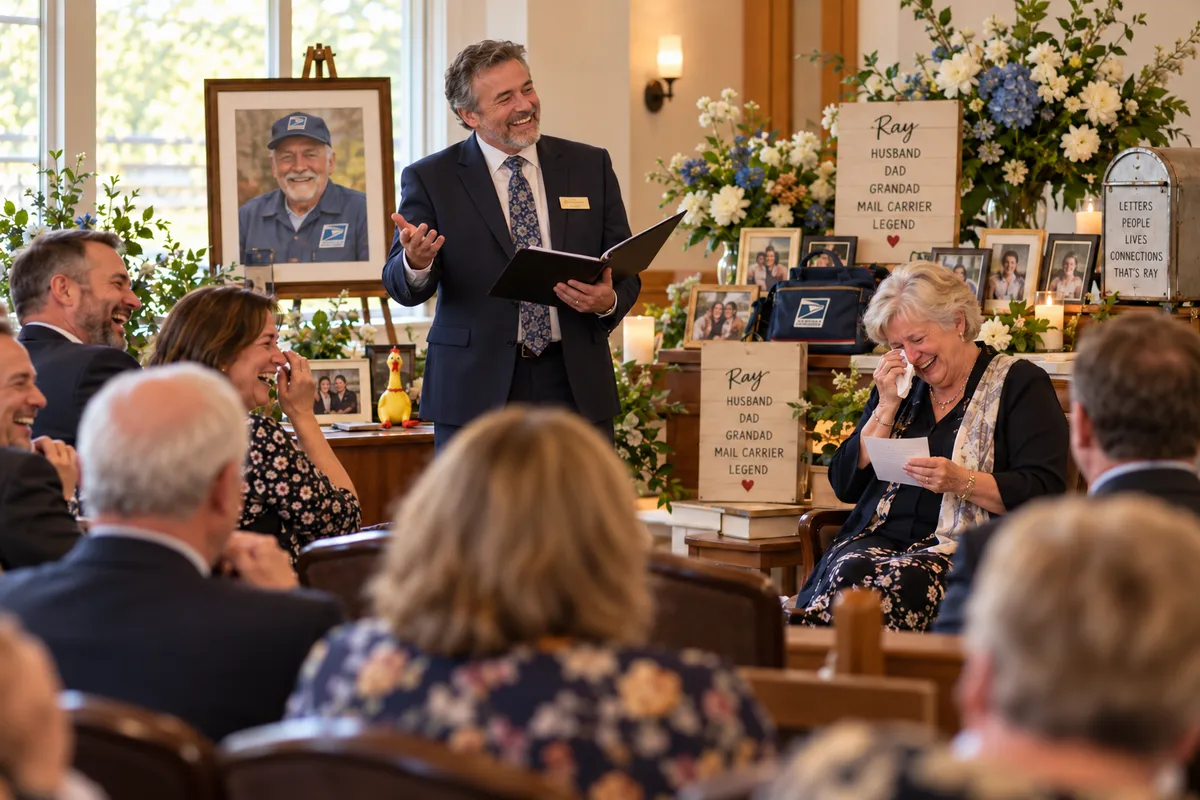
She was probably right. Ray spent thirty-four years as a mail carrier and roughly the same amount of time perfecting the art of the practical joke. He once mailed his brother a single brick, postage due. For four decades, a rubber chicken had moved silently around the family, turning up in suitcases, Christmas stockings, and on one memorable occasion, a wedding cake box. Nobody ever admitted to moving it. Everybody knew who had started it.
When Ray died at seventy-four, Carol and her two sons wanted something, but they could not picture what. A solemn hour in a dark room felt like a lie. Doing nothing felt worse.
The funeral director suggested they meet with a Celebrant.
The first conversation
Bob, the Celebrant, came to the house and sat at the kitchen table for almost two hours. He did not ask about Ray's career highlights. He asked what he did on Saturday mornings, what he always said when he walked in the door, what made him angry, and when the family had last seen him cry.
The answers surprised even his sons. Ray read the comics before the front page every day of his life. He said "Honey, I'm famous" every time he came home, and nobody knew why. He cried exactly twice that anyone could remember, both times at a granddaughter's dance recital.
And every year since 1979, he had left a small note in Carol's lunch bag on their anniversary. She had kept all of them.
Building the ceremony
Bob wrote a ceremony that opened with Ray's favorite record, a big band tune he used to whistle on his route. He told his story in about twelve minutes, and he told it the way he would have, with the brick and the comics and the "Honey, I'm famous." He invited each son to tell one story, and he worked with them on their stories ahead of time so they could get through without having to stop.
Then Bob asked Carol a question nobody else had thought to ask. Where was the rubber chicken right now?
Carol knew. It had been in Ray's sock drawer since Easter.
The moment
About halfway through the ceremony, Bob paused. He told the room that Ray had always believed no gathering was complete until someone was embarrassed, and that the family felt it would be wrong to break with tradition now. Then he asked everyone to look under their chairs.
Ray's eleven-year-old grandson found it.
The room came apart. People laughed so hard they had to wipe their eyes, and then some of them kept wiping their eyes after the laughing stopped, because it was that kind of laugh. Bob let it run. He did not rush to fill the silence afterward.
When the room settled, Carol walked to the front and read the note from Ray's first anniversary lunch bag in 1979. It was four lines long. It was not funny at all.
What the laughter did
Families sometimes worry that laughter at a farewell is disrespectful. It is not. Laughter is often permission. It tells everyone in the room that they are allowed to remember the whole person, not a cleaned-up version, and that grief and joy can sit in the same chair. For a man like Ray, a farewell without laughter would have been a farewell for somebody else.
But laughter alone would not have been enough either. What made the ceremony work was the turn from the chicken to the note. Someone had to know that the room needed both, and in that order.
That is a Celebrant's craft. Bob did not invent anything about Ray. Every piece came from the family. His job was to listen for the right pieces, set them in the right order, and lead the room through them so Carol and the boys did not have to.
What came after
People stayed for two hours after the ceremony ended. Strangers on his old route introduced themselves to Carol and told her that Ray was the only person they ever saw on a Tuesday.
The rubber chicken is now in an undisclosed location. Carol says she is not worried. She says it will turn up when it is needed.
Your next step
Ask the funeral team in your area about the Celebrants they work with and what a first conversation with one would look like.