
Why Gathering Matters: The Days When People Simply Show Up
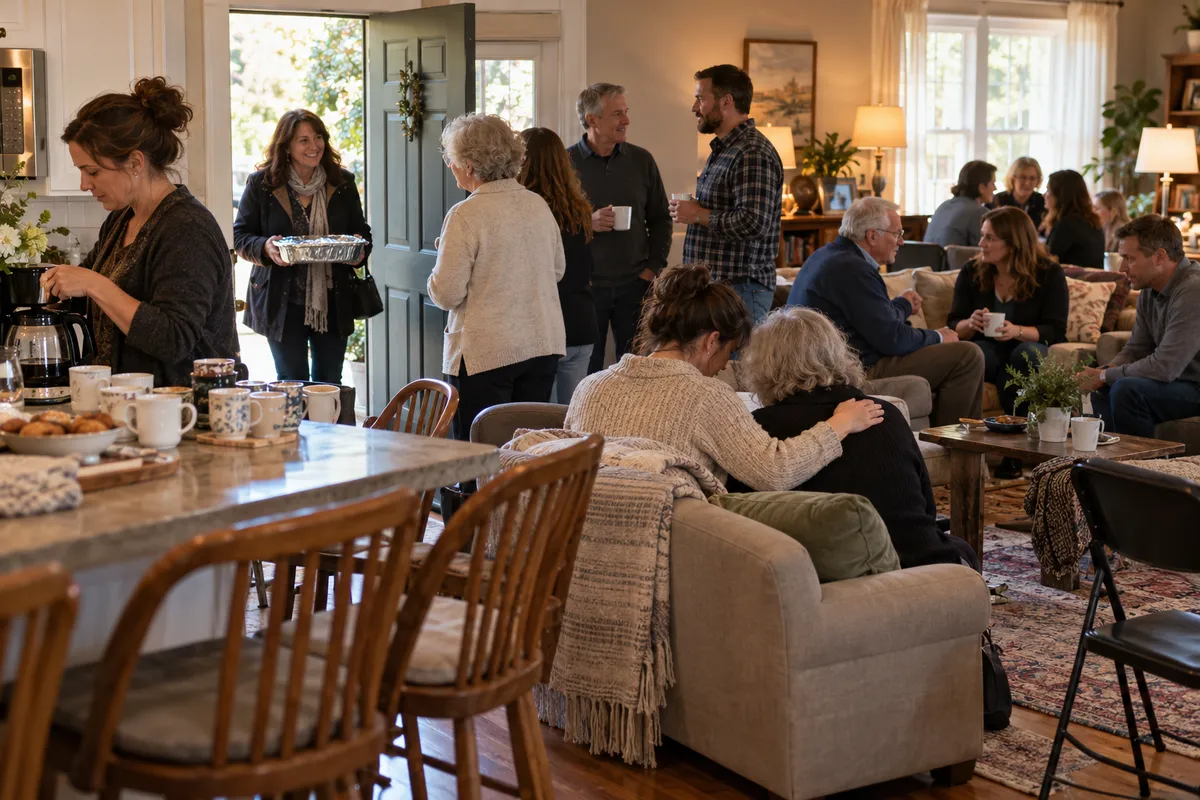
The first knock usually comes sooner than you expect. A neighbor stands on the porch holding a casserole dish wrapped in foil, still warm, not quite sure what to say. An hour later a cousin arrives who drove four hours without calling ahead. By evening there are eleven people in the kitchen, the coffee maker has not stopped, and nobody planned any of it.
That is a gathering. People have been doing this for as long as there have been people to lose. Before anyone writes an obituary or chooses music, the instinct is simply to be near one another, to tell the stories, and to make sure the people closest to the loss are not sitting alone with it.
A gathering is not a ceremony
Families sometimes treat the gathering and the farewell ceremony as the same event. They are not, and understanding the difference opens up choices. A ceremony has a shape. There is a beginning and an end, someone speaks, and the room moves through a planned moment of goodbye together. A gathering has almost no shape at all. People arrive and leave on their own schedule. Some stay ten minutes and some stay all afternoon. The conversation wanders from the hospital to the fishing trip in 1987 and back again.
Both matter, and they do different work. The ceremony gives the goodbye a moment. The gathering gives it time.
It does not have to be a traditional visitation
For generations the gathering took one familiar form: a visitation at the funeral home, with the casket open and the family standing in a receiving line for three hours. That still means a great deal to many families, and it remains a fine choice. It is also only one choice.
A gathering can happen with or without the person present. It can follow a cremation that has already taken place. It can be an open house on a Sunday afternoon, a long table at a favorite restaurant, an evening in the backyard with the porch lights on, or a room at the funeral home arranged to feel like a living room. The question is not which format is correct. The question is where the people who loved this person will feel comfortable enough to stay a while.
Someone still has to host
Here is the part families rarely think about until they are in the middle of it. Every gathering has a host, and hosting is work. Somebody has to figure out where people will park, whether there are enough chairs, who is bringing food and who is cleaning up, how Aunt Ruth and her walker will get up the front steps, and when it is polite to start wrapping things up.
When the family hosts, that somebody is usually the person who should be sitting down. The daughter who was closest to her mother ends up refilling the ice bucket.
This is where a funeral home team earns its keep, and it has very little to do with the building. Most funeral teams will help with a gathering wherever it happens, whether that is their own space, your home, a park pavilion, or a restaurant. They have done this hundreds of times. They know how many chairs sixty people need, what to do when it rains, and how to ease the last guests toward the door without anyone feeling rushed. Their job is to take on the host's work so the family can do the one thing nobody else can do for them, which is to be present.
What happens when there is no gathering
Some families decide to skip it. Life is busy, people are scattered, and it can feel easier to let everyone grieve on their own. That is a legitimate decision, and nobody should be shamed for it.
It is worth knowing what gets lost, though. The gathering is where people learn things they never knew. The quiet man from the hardware store mentions that your father covered his rent one hard winter and never told a soul. The stories that come out in a crowded kitchen are the ones that would never have surfaced on a phone call. Families who skip the gathering often find that the grief they postponed shows up later, in an empty house, with no one there to share it.
A gathering does not need to be large or formal or expensive. It only needs to happen.
Your next step
When you talk with a funeral team, ask how they help with gatherings and whether they will support one at your home or another place that matters to your family. Most will, and many families never think to ask.